

Our users reported over 96% customer satisfaction for the last 10 years. Schedule a personal tour of our software to see how we can improve your business’s productivity.
Table of Contents
Share Article
Summer in construction is a unique challenge. Projects stack up, crews expand and the pace that felt manageable in March starts to feel like a controlled sprint by June.
For contractors who depend on accurate labor data to run payroll, manage job costs and keep projects on schedule, a surge in workers isn’t just an operational win; it’s also an administrative stress test.
A mobile time tracking app keeps construction payroll and job costing accurate during the busy season by moving time capture to the field, where crews clock in and out, log cost codes and submit hours in real time. That removes the paper backlog that builds when crew size spikes. WorkMax provides construction-specific mobile time tracking built to scale with crew size and jobsite count.
Key Takeaways
- Summer construction activity peaks create a surge in field labor that puts real strain on manual time tracking processes
- A mobile time tracking app lets workers clock in and out from the field without requiring office intervention
- Real-time labor data gives supervisors visibility across multiple crews and jobsites simultaneously
- Accurate time capture during high-volume seasons feeds directly into payroll and job costing without adding administrative work
- WorkMax® provides construction-specific mobile time tracking designed to scale with crew size and project complexity
What Happens When the Workforce Scales Up
Construction employment rises sharply from late winter to late summer, expanding the field crews that feed payroll and job costing.
According to Federal Reserve Bank of Chicago research, construction employment runs roughly 10% below its annual average in February and climbs to about 7% above that average by August, a swing that represents a significant surge in active workers over just a few months.
That growth is welcome on the revenue side. On the operations side, it creates real friction. More workers means more timecards, more cost code entries, more payroll records to verify and more chances for something to slip through before Friday’s processing deadline.
When every construction firm is competing for workers at the same time, project managers who wait until they have a staffing problem to act are already behind. The same logic applies to the systems those workers feed into.
If the time tracking process can’t scale alongside the workforce, the administrative backlog that results hits payroll, job costing and project reporting all at once.
Why Manual Tracking Breaks Down in Peak Season
Manual time tracking works well enough when crews are small and consistent. The same foreman sees the same ten people every day, knows who showed up and can fill in a paper timesheet with reasonable accuracy by memory.
Scale that crew to thirty people across two or three active jobsites and the math changes. Memory becomes unreliable.
Paper gets lost. Timesheets arrive at the office late, incomplete or conflicting, and someone on the admin side has to chase the difference before payroll can close.
Accurate time tracking connects labor hours to job costing, payroll and project performance, but only if the data coming in is clean and timely.
During peak season, the volume of entries that need to be reviewed, corrected and approved before processing grows significantly.
Any system that depends on manual collection and office reconciliation tends to show its limits right when the pace is highest.
What a Mobile App Changes

A mobile time tracking app shifts data entry to the field, where the work is actually happening.
Workers clock in and out from their phones, log their task and cost code in real-time and submit entries without requiring a foreman to compile anything by hand at the end of the day.
For contractors managing an expanded summer crew, that shift has a direct impact on a few things.
Speed of data
When time is captured in the field as the day unfolds, supervisors and office staff aren’t waiting on paper to arrive or on someone to remember what happened three days ago. The data is there when it’s needed.
Visibility Across Crews
A mobile app connected to a central platform gives project managers a view across multiple jobsites at once.
During a season when crews are working in more places simultaneously, this real-time visibility helps supervisors catch issues like a missed clock out, a worker assigned to the wrong cost code, before they become payroll problems.
Less Administrative Lift
Digital time tracking solutions make it easier to capture accurate field data and share it between crews, supervisors and office teams.
When that data is clean coming in, the approval and processing cycle shortens, which matters when the volume of entries has doubled from what it was in the spring.
Those advantages hold whether a contractor is managing the same crew from last fall or adding ten new workers to the roster by the end of the week.
Keeping Payroll Accurate When the Crew Keeps Growing
Mobile time tracking scales to new workers without added hardware or setup, keeping payroll accurate as headcount fluctuates.
One of the more practical challenges of peak season is onboarding new workers into an existing time tracking system quickly.
Every temporary or seasonal hire added to the crew is another person who needs to clock in accurately, log to the right cost codes and submit time that feeds cleanly into payroll.
Once a user is added to the system, they’re tracking from day one. That consistency (the same process applied to every worker regardless of when they joined the crew) is what keeps payroll accurate when headcount fluctuates week to week.
It also matters for job costing. When labor hours are captured against the right cost codes in real-time, project managers can see how actual labor spend is tracking against the budget throughout the season rather than discovering a variance after the fact.
During a period when projects are running simultaneously and crews are moving between jobs, real-time cost visibility is difficult to achieve without a mobile-first system.
WorkMax for Busy Season
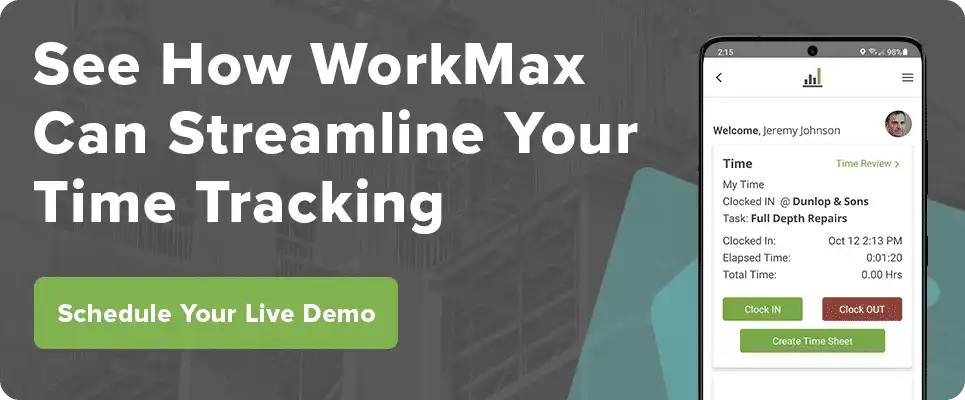
WorkMax is built for the pace and complexity of active construction seasons. The time tracking mobile app gives field workers a straightforward way to clock in and out, log time against cost codes and submit hours from wherever the work is, without depending on paper or office follow-up to get that data where it needs to go.
For supervisors managing expanded summer crews, WorkMax provides real-time visibility into who is where and what they’re working on across all active jobsites.
For payroll and accounting teams, it means accurate, complete records arriving for approval rather than a stack of timesheets to reconcile before the pay period closes.
Whether a contractor is scaling from ten workers to thirty or managing a consistent peak-season crew through a busy summer, WorkMax keeps the time tracking process from becoming the bottleneck.