

Our users reported over 96% customer satisfaction for the last 10 years. Schedule a personal tour of our software to see how we can improve your business’s productivity.
Table of Contents
Share Article
Ask most contractors what slows their crews down, and you’ll hear the same things: timecards that don’t add up, reports that show up late and hours that nobody can quite account for.
It’s not a field problem or an office problem — it’s a data problem.
When information from the field lives in too many places — paper timecards, email threads, a spreadsheet someone started six months ago — it gets harder to keep a clear picture of any job.
Payroll takes longer. Project reviews get messy. And small problems that could have been caught early have a way of turning up later in the margins.
These aren’t isolated headaches — they’re what happens when construction workforce management has no central home.
For contractors running crews across multiple sites, the challenge gets bigger fast. Labor hours logged on paper, equipment tracked in a spreadsheet somewhere, forms filled out and emailed in — it all ends up scattered.
And when data is scattered, the picture you’re working from is always incomplete.
Key Takeaways
- One central system means your field and office are always working from the same information
- Centralizing your jobsite data gives your office a real-time view of what’s happening on the ground
- Tracking labor, equipment and project progress in one place helps you catch problems early
- A single source of data makes payroll, compliance and reporting faster and more accurate
- Mobile-first tools built for construction make it easy for your crew to submit accurate data without slowing down the work
What It Means to Consolidate Field Data
Consolidating field data means pulling all the information generated on your jobsites — hours worked, equipment used, forms submitted, project milestones hit — into one system that your office and field can both access.
Think of it as construction data management: replacing the scattered, manual pieces with centralized jobsite data that everyone works from.
Right now, your information may live in a lot of pieces. A foreman writes hours on a paper timecard. Someone else logs equipment usage in a spreadsheet. Daily reports go out over text or email.
The office has to collect all of it, make sense of it and hope nothing got lost or misread along the way.
When you bring that all together in one place, you get something that none of those pieces give you on their own: a complete, accurate picture of the job.
Why Silos Slow You Down
A data silo is just what it sounds like — information that’s stuck in one place and can’t easily connect to anything else.
In construction, silos happen quickly. The field operates one way; the office operates another and the two don’t always talk to each other in real-time.
The problem isn’t that the data doesn’t exist. It’s that it takes too long to collect it, reconcile it and act on it. By the time the office figures out a job is running over on labor hours, the crew has already put in another week.
The Real Cost of Disconnected Jobsite Information
Picture it from the office side:
It’s Friday afternoon. Payroll needs to run and timecards are still trickling in from three different jobsites.
At the end of the week, those timecards come in — some on time, some late, some with corrections. Your office staff spends hours sorting it out before payroll can run.
If anything doesn’t match up, you’re back on the phone with the foreman trying to piece together what happened four days ago.
That’s time your office doesn’t get back. And if there are errors in those hours, labor cost tracking becomes guesswork — and guesswork shows up in your margins.
Labor Compliance Adds Another Layer
For contractors working on government projects or prevailing wage jobs, the stakes get even higher.
Certified payroll compliance requires precise, accurate records for every worker on the job. When your data is fragmented, pulling those reports becomes a manual process that’s prone to error.
A mistake on a certified payroll submission isn’t just inconvenient — it can hold up payment or create compliance issues that take real time to resolve.
When all your labor data flows into one system, certified payroll reports are based on the same numbers that drove your timecards. There’s no reconciling two different sets of records.
What Changes When You Centralize Your Workforce Data

When jobsite data flows into one place, the biggest shift is visibility. You go from finding out what happened to seeing what’s happening.
That difference matters a lot when you’re trying to keep a job on budget.
Take job costing as an example. Job costing is the process of tracking your actual labor, material and equipment costs against what you estimated.
When that data comes in live — instead of at the end of a pay period — you can compare estimated hours to actual hours as the work progresses. If labor on a framing crew is trending 15% over estimate in week two, you know in week two.
That gives you time to adjust scheduling, reassign resources or have a conversation with the crew before the overrun compounds.
When Field and Office Work From the Same Numbers
One of the most common friction points between field and office is working from different information. The foreman says one thing, the system shows another and someone has to figure out which version is right.
When your field crews clock in and submit forms through the same app that feeds your back office, everyone is working from the same data.
Workforce visibility stops being a question mark. There’s no “our version” and “their version” — the numbers match because they came from the same place.
Spotting Patterns Across Jobs
Centralized data also gives you a longer view. Over time, you can start to see which job types consistently run over on certain trades, which crews are most efficient or where equipment tends to sit unused between tasks.
That kind of visibility is hard to come by when every job keeps its data in a separate folder or spreadsheet.
When it all lives in one system, the patterns emerge on their own — and they make you a better estimator and a better manager over time.
How the Right Tools Make Field Data Collection Simple
The most common concern contractors have when switching to a digital system is whether the crew will use it. And that’s a fair question.
If a tool is complicated, slow or requires a solid cell signal in a basement or a rural site, it creates friction — and friction is what gets in the way of consistent use.
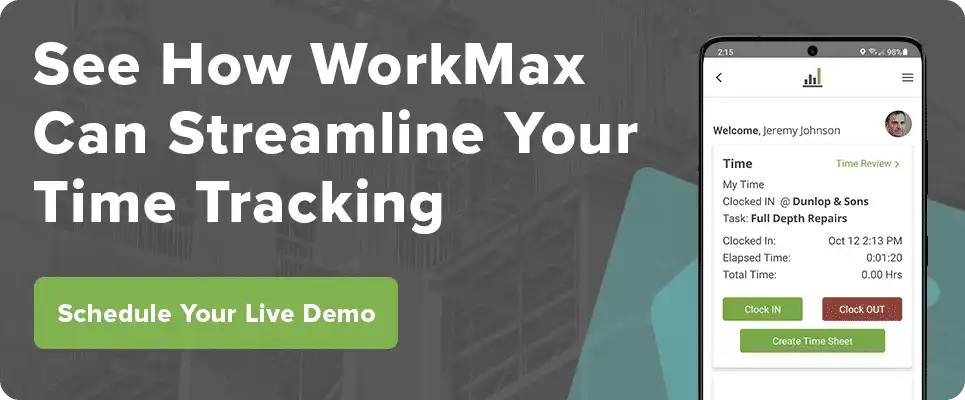
The tools built specifically for construction account for these realities. Mobile time tracking with GPS-verified clock ins, offline access that syncs when a connection is available, simple pin entry and Spanish language support for diverse crews — these are what makes construction time tracking adoption stick across your whole crew.
From Clock In to Close-Out in One App
A mobile workforce management app that ties together time, forms, equipment and project progress means your foreman doesn’t need three different tools to close out a day.
Before anyone leaves the site, the crew is clocked out, the daily report is submitted, and equipment hours are logged — all in the same place.
That information hits the office the same day.
There’s no waiting on paperwork, no deciphering handwriting and no chasing anyone down the next morning.
WorkMax® Was Built for the Way Construction Works
Not all solutions are built with construction crews in mind, though. The ones that work are the ones designed specifically for the way the field actually operates.
Keeping your field and office aligned comes down to having one reliable place where job site information lives.
WorkMax is a construction mobile app with four modules:
- TIME
- FORMS
- ASSETS
- INSIGHT
All modules are connected in one control center. Each module works on its own, but together they give you a full picture of labor hours, form submissions, equipment usage and project progress in real-time.
No double entry. No manual transfers.
If you want to see how WorkMax simplifies construction field data collection for your crew, book a demo with one of our experts.