
Our users reported over 96% customer satisfaction for the last 10 years. Schedule a personal tour of our software to see how we can improve your business’s productivity.
Table of Contents
Share Article
Time tracking sits at the front of the payroll and job costing pipeline. What gets captured in the field (hours, cost codes, tasks, locations) flows directly into the financial systems that construction accountants depend on to do their jobs.
When that data is accurate and arrives on time, everything downstream runs more smoothly. When it isn’t, the problems follow the data all the way through payroll processing and financial reporting.
That’s why construction accountants and payroll processors have a stake in the time tracking software their company uses, even when that software lives on a field worker’s phone rather than in the accounting department.
Key Takeaways
- Time tracking data is the starting point for payroll processing and job costing, making its accuracy a financial concern, not just an operational one
- Manual time collection introduces errors that compound as data moves from the field into accounting and payroll systems
- Integration between time tracking software and accounting or payroll platforms removes the need for manual data transfer and reduces the risk of entry errors
- Accurate cost code assignment at the timecard level is what makes job costing by phase and task possible
- WorkMax® integrates with leading construction accounting software and payroll services to give accountants clean, reliable field data from the moment payroll runs
Time Tracking Data Is Financial Data
Construction accountants work with the numbers that come out of a project. But those numbers start in the field, with a worker clocking in, selecting a cost code and logging the task they’re working on.
Every decision made downstream, from payroll calculations to job cost reports to billing, depends on that field entry being correct.
The challenge is that time tracking has historically been handled through paper timesheets or disconnected spreadsheets, both of which require someone to manually transfer data into accounting and payroll systems.
Manual transfer means manual entry, and manual entry means opportunities for error at every step. Transposing a cost code, misreading handwriting or entering hours for the wrong day can send the wrong data into the financial systems accounting teams rely on.
And for a construction accountant, bad time data doesn’t stay in the field. It shows up as a discrepancy in the job cost report, as a payroll error that has to be corrected or as a billing dispute that takes hours to trace back to the source.
How Time Tracking Integrations Change Accounting Accuracy
When a time tracking app integrates with accounting and payroll software, the data path from the field to the financial system becomes direct. Workers log hours in the app, supervisors then review and approve in the same system and the approved time flows into payroll and job costing without anyone needing to retype it.
That single change addresses most of the error risk in the traditional process: there’s no transcription step, there’s no delay while someone waits for paper timesheets to arrive at the office and there’s no version of the data that exists in one place but not another.
For payroll processors, integration means the hours they’re calculating payroll against reflect what was submitted and approved in the field, not what someone typed in. For accountants, it means job cost data updates as payroll is processed rather than requiring a separate manual entry step.
The result? A tighter, more reliable data pipeline from the moment a worker clocks in to the moment a job cost report is generated.
Cost Code Accuracy and Job Costing
Job costing in construction requires more than knowing how many hours were worked on a project. It requires knowing which hours went to which phase, which task, which cost code. That level of detail is only available if the time tracking system captures it at the point of entry.
When workers log time against specific cost codes as they move through the day, that data becomes the basis for phase-level job cost reports.
So, a project manager can see how estimated hours compare to actual hours by cost code and an accountant can see where labor costs and payroll burden are accumulating within a project and whether they’re tracking to budget.
Without that cost code detail, labor shows up as a project total that can’t be broken down or compared against the estimate.
This is where field-level entry in a time tracking app matters beyond just capturing clock in and clock out. A system that makes it easy for workers to assign time to the right cost code produces data that serves accounting too.
Reporting That Fuels Accounting Decisions
Beyond payroll and job costing, the data that flows through a time tracking system can support a range of financial reporting needs, too.
When time is captured digitally and connected to accounting systems, that data can support:
- Labor hours by employee
- Productivity by task
- Hours against prevailing wage thresholds
- Location data for geofence-based compliance tracking
Accurate field data means WIP schedules reflect real labor costs and cash flow projections aren’t built on hours that will need correcting later.
The same logic applies directly to job costing reports too. Job labor reports, phase-level cost breakdowns and estimated-versus-actual comparisons all depend on that same detailed time data.
Getting Time Tracking Data Right From the Start
Time tracking touches nearly everything a construction accountant works with: payroll accuracy, job cost detail, WIP reliability and the reports that depend on all three.
The earlier and more accurately that data is captured in the field, the less time accounting and payroll teams spend correcting it downstream.
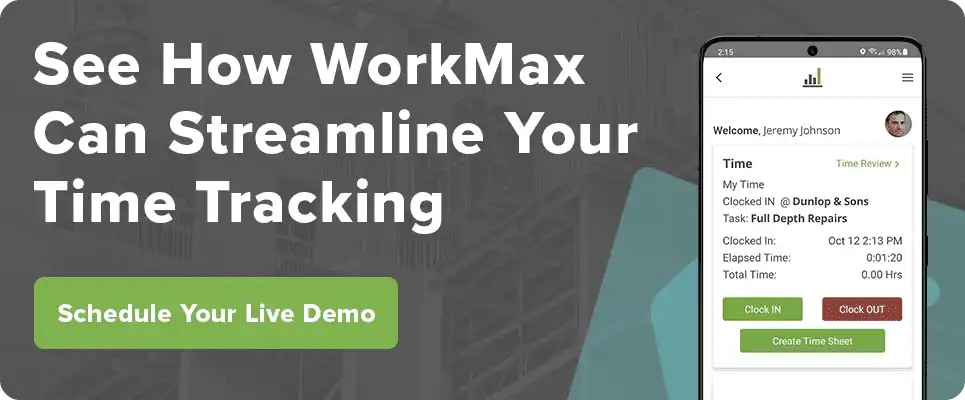
Time tracking solutions like WorkMax are built with that in mind. Workers clock in, log time against cost codes and submit entries digitally from the mobile app, while supervisors review and approve through the same platform before anything moves downstream.
WorkMax also integrates with construction accounting software and payroll services, including FOUNDATION® construction accounting software, so approved time flows into payroll processing and job costing without manual transfer.
For construction accountants and payroll processors who spend time correcting errors that originated in the field, WorkMax addresses the problem at the source, in the app, where time is first recorded.