

Our users reported over 96% customer satisfaction for the last 10 years. Schedule a personal tour of our software to see how we can improve your business’s productivity.
Table of Contents
Share Article
Construction data analytics gives contractors real-time insight into labor, costs and job performance so they can make better decisions while work is still in progress.
Data analytics have become one of the most important tools a contractor can have — and in today’s market, it’s easy to see why.
For contractors, “data analytics” comes down to something practical: knowing whether labor hours, project costs and field productivity are tracking where they should be while work is happening, not after it’s too late to respond.
That real-time visibility is what separates contractors who catch problems early from those who find out at month-end.
Interest rates are up. Material costs are still unpredictable. Labor is expensive and hard to find.
When margins are this tight, a two-week-old labor overrun that you’re just now finding out about isn’t a reporting lag. It’s a real threat to your bottom line.
The contractors staying ahead of it aren’t operating with a fundamentally different set of resources. They’re just seeing their jobs more clearly — while there’s still time to act on it.
Key Takeaways
- Waiting until month-end to review job costs is too slow in a high-cost environment — by then, it’s too late to correct course
- The gap between what’s happening in the field and what the office sees is where most overruns are born
- Real-time labor tracking and project progress tools close that gap and give you options before small problems become big ones
- Companies that adopt data-driven workflows are outperforming their competitors on profit growth by a significant margin
- WorkMax TIME, FORMS, INSIGHT and ASSETS connect field data to the office in real time, giving contractors the visibility they need to stay in control of their jobs
The Old Way of Tracking Projects Doesn’t Work Anymore
Delayed reporting methods hide problems until it’s too late to fix them — and that’s where most jobs start to go sideways.
For a long time, the monthly job cost report was good enough.
You’d look at the numbers, see where you were over or under and adjust. Profit margins were wide enough that a little overrun could be absorbed without much consequence.
That’s not the world we’re living in right now.
Material prices remain elevated since the pandemic. Interest rates have pushed financing costs up for owners and general contractors alike.
And labor — the single biggest variable on most jobs — has gotten more expensive and harder to manage.
FMI’s 2023 Labor Productivity Study found that the construction industry loses between $30 and $40 billion every year due to labor inefficiencies.
When every dollar counts, waiting 30 days to find out a job is going sideways isn’t a reporting lag — it’s a liability.
What Construction Data Analytics Actually Means

Construction data analytics means turning field data into real-time insight so you can see whether your jobs are actually performing the way you expect.
It’s all about knowing at any moment whether your crews are hitting targets, whether your labor spend matches your estimate and which job is burning hours it shouldn’t be.
In practice, that means turning raw field data into actionable insights that improve job costing accuracy and labor productivity. These insights include cost variance analysis, labor tracking and construction key performance indicators (KPI) that compare actual results against project estimates.
Most contractors already collect this data. The problem is it lives in paper timecards, crew texts and end-of-week foreman reports — none of which make it into a system until it’s too late to act on. The data exists. It just arrives late.
Getting that data flowing continuously, as it happens, is what construction data analytics is really about. And the payoff is significant.
According to an Autodesk and Deloitte study, contractors classified as “data leaders” see a 50% higher annual profit growth rate than their peers.
Why Seeing Labor Overruns Early Changes Everything
Catching labor overruns early gives contractors time to adjust, stay on budget and avoid problems that spiral out of control.
Here’s a scenario most contractors have lived through:
A job is tracking fine in week one. In week two, a crew runs into something unexpected — a scope issue, a productivity problem or a weather delay. Hours start stacking up.
By the time you see it in the numbers, you’re already three weeks deep into an overrun.
Now imagine catching it early.
You call the super, find out what’s going on and adjust — redeploy resources, have a conversation with the owner or adjust the size of the crew for the rest of the week.
You have options early on that you simply don’t have at month-end.
Research shows that 85% of construction projects fail to stay within budget — and most of those overruns aren’t inevitable. They were just spotted too late.
How WorkMax® Helps You See Problems Before They Get Expensive
WorkMax turns construction data analytics into something practical by connecting field data to the office in real time.
Making adjustments before cost overruns get out of hand, using real-time data, is exactly the problem WorkMax was built to solve.
It’s a mobile time tracking platform that connects the field and office instantly — so the data your crews generate on the jobsite shows up in your system the same day, not at the end of the week.
Accurate Labor Hours From the Field
Accurate labor data is the foundation of construction data analytics, and it starts with capturing hours correctly in the field.
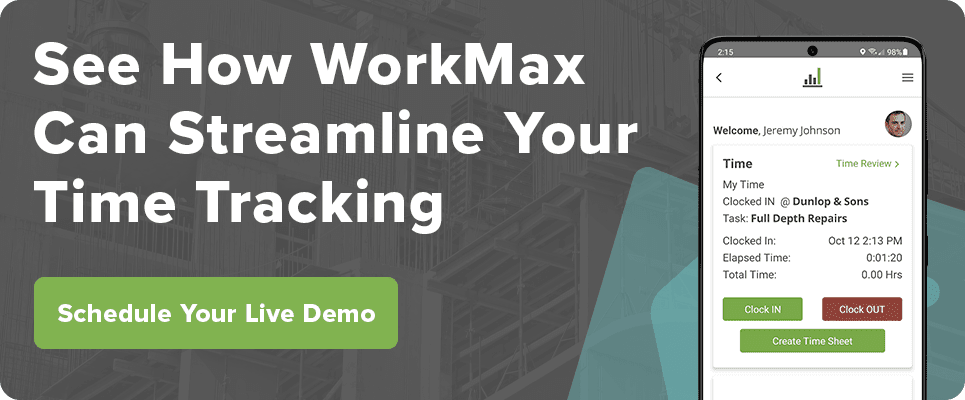
WorkMax TIME uses GPS technology and geofencing to capture labor hours the moment workers clock in and out. No paper timecards. No calling around on Friday to reconstruct the week.
The data flows directly to your accounting and payroll platforms, so your job cost reports are always current. Not a week behind.
Project Progress Tracking With WorkMax INSIGHT
WorkMax INSIGHT brings construction data analytics to life by turning job data into real-time project performance insights.
It lets you track project trends and monitor progress against your budget in real time, so you can catch a problem while it’s still manageable.
You can see budget vs. actual labor spend, production milestones and performance trends across all your jobs — updated as each day unfolds.
Streamlined Jobsite Documentation With WorkMax FORMS
Construction data analytics depends on consistent, real-time documentation from the field to stay accurate.
WorkMax FORMS lets your crews build and submit custom digital forms — daily reports, safety checklists, inspection logs — directly from the field. Submissions are completed and sent back to the office before workers clock out, so your documentation is organized, timestamped and easy to act on. No chasing paper, no end-of-week reconstruction.
Equipment Visibility With WorkMax ASSETS
Understanding how equipment is used across jobs and crews is a key part of making smarter, data-driven decisions.
WorkMax ASSETS links equipment usage directly to the jobs and activities where it’s deployed. You can track utilization across your entire fleet and run reports to see which tools are idle, overused or misallocated — so equipment decisions are backed by data, not guesswork.
The Competitive Advantage Is Real
Contractors who rely on real-time data to guide decisions consistently outperform those working off delayed reports.
A recent study found that the construction industry as a whole is still in the early stages of putting data to work.
That makes this an early-mover moment. The shift to real-time field data is underway — but most of the industry hasn’t made it yet.
Contractors who make the shift now have an edge. Construction businesses using field data insights to their advantage aren’t just running tighter jobs today.
They’re evolving their processes for smarter estimating, better forecasting and stronger bids over time. Every job becomes a data point that makes the next one more predictable.
The gap between what’s happening in the field and what you can see from the office is where profit disappears. It doesn’t have to be that way.
Talk to a WorkMax expert and see how real-time field data can change how you run your jobs.